Early Life Health Interventions and Academic Achievement
Abstract
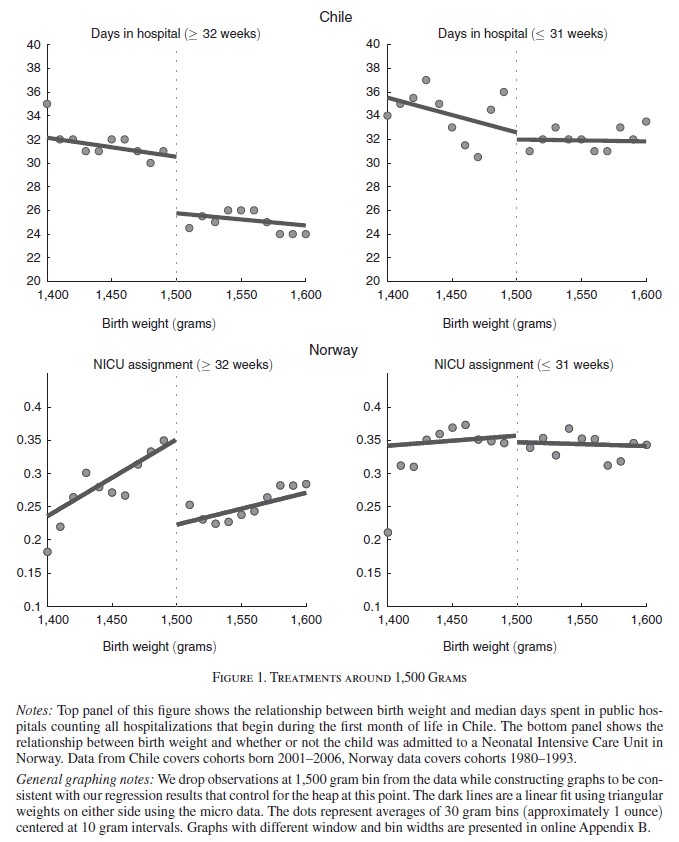
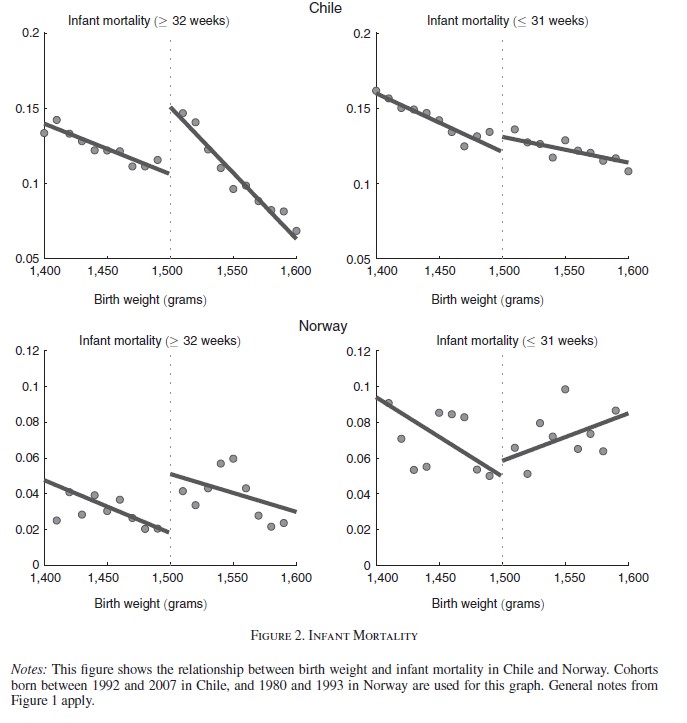
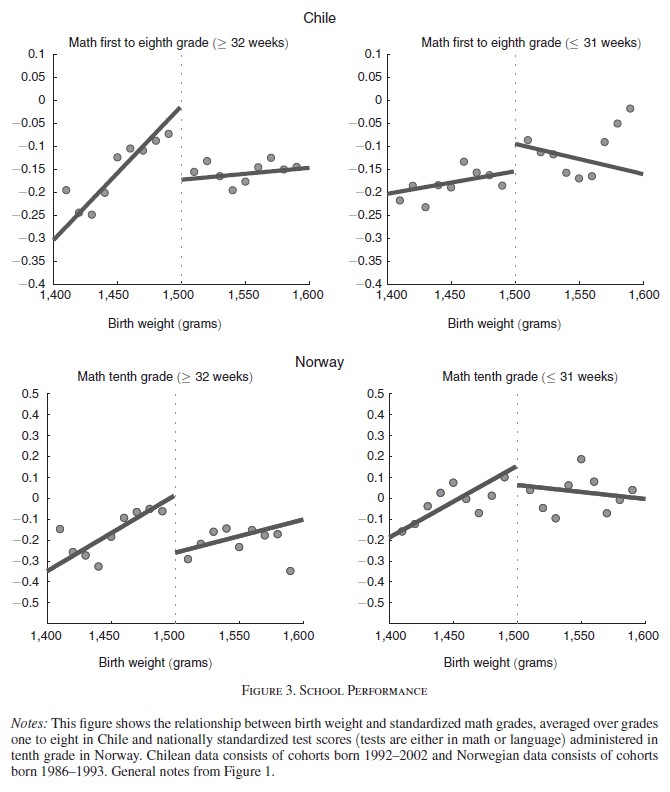
This paper studies the effect of improved early life health care on mortality and long-run academic achievement in school. We use the idea that medical treatments often follow rules of thumb for assigning care to patients, such as the classification of Very Low Birth Weight (VLBW), which assigns infants special care at a specific birth weight cutoff. Using detailed administrative data on schooling and birth records from Chile and Norway, we establish that children who receive extra medical care at birth have lower mortality rates and higher test scores and grades in school. These gains are in the order of 0.15-0.22 standard deviations.
Prashant Bharadwaj, Katrine Vellesen Løken, Christopher A. Neilson, "Early Life Health Interventions and Academic Achievement", American Economic Review, Vol. 103, No. 5, August 2013, (pp. 1862-91), 2013, doi: 10.1257/aer.103.5.1862.
@article{ early-life_2013,
  title = {Early Life Health Interventions and Academic Achievement},
  author = {Bharadwaj, Prashant and Løken, Katrine Vellesen and Neilson, Christopher A.},
  journal = {American Economic Review, Vol. 103, No. 5, August 2013, (pp. 1862-91)},
  year = {2013},
  doi = {10.1257/aer.103.5.1862},
  abstract = {This paper studies the effect of improved early life health care on mortality and long-run academic achievement in school. We use the idea that medical treatments often follow rules of thumb for assigning care to patients, such as the classification of Very Low Birth Weight (VLBW), which assigns infants special care at a specific birth weight cutoff. Using detailed administrative data on schooling and birth records from Chile and Norway, we establish that children who receive extra medical care at birth have lower mortality rates and higher test scores and grades in school. These gains are in the order of 0.15-0.22 standard deviations.},
  url = {https://www.christopher-neilson.com/work/documents/BVN_2013_AER.pdf},
  url_article = {https://www.aeaweb.org/articles?id=10.1257/aer.103.5.1862}
}
Published version (PDF) - Bibtex
Main Graphs from the paper
Cited in policy and practice
- A Complete Dual Economy
- Food for Thought? Breastfeeding and Child Development
- Can the Knowledge Capital Model Explain Foreign Investment in Services? The Case of Singapore
- Breastfeeding and child development
- Partial insurance and investments in children
- The Medium Term Impacts of Cash and In-Kind Food Transfers on Learning
- Recovery from an early life shock through improved access to schools: Evidence from Indonesia
- A Complete Dual Economy
- A Complete Dual Economy
- Coauthors: ,
- Published: American Economic Review, Vol. 103, No. 5, August 2013, (pp. 1862-91) · collecting cites
- Date: 2013
- Citations (Google Scholar): 411