
Policies that Recruit, Retain and Promote Teacher Talent
A series of studies on promoting teacher quality in Chile
A long-running agenda on how Chile's pre-college admission scores, financial-aid policies, and teacher-licensing rules shape who becomes a teacher — and what classrooms look like as a result.
Policies that Recruit, Retain and Promote Teacher Talent
The most recent study in this agenda — Teacher Preparation, Pre-College Human Capital and Student Learning: Evidence from Enseña Chile (De Gregorio, Neilson & Gallegos) — links administrative pre-college admission scores (PSU/PAA) to teacher value-added measured from student test gains. It provides the first individual-level decomposition of selection-on-ability versus experience for a Teach For All affiliate, separating how much of the alternative-pathway effectiveness gap reflects who the program recruits, how long they stay, and how they are trained.
- Location: Chile and Peru
- Partners: Ministry of Education - Chile
- Date: May 2006 - 2017
- Principal Investigators:
Extended abstract
Why do Teach For America–style alternative pathways reach roughly comparable test-score results to traditional teacher preparation, despite far shorter coursework? The usual answers are selection on cognitive ability and intensive coaching on the job — but the two have been almost impossible to separate, because few studies have both individual pre-college ability scores for the relevant teachers and the student panel data needed to estimate value-added.
We do exactly that for Enseña Chile (eCh), the Chilean Teach For All affiliate. We built a purpose-designed linked dataset — 114 mathematics teachers (37 eCh, 77 traditional), 169 classes, 3,756 students across 59 schools in grades 9–11 — combining research-administered beginning- and end-of-year SEPA mathematics tests with administrative college-entrance scores (PSU/PAA) and the MINEDUC Docentes experience panel. This lets us measure each teacher’s value-added and decompose the eCh–traditional gap into pre-college ability, experience, and a route-of-preparation residual.
Reweighted to the national common-support ability distribution, the eCh–traditional value-added gap is −0.16σ — and it splits into three offsetting pieces: a positive contribution from who the program recruits, a first-year inexperience penalty, and a route residual we cannot statistically distinguish from zero. In short, eCh teachers are recruited near the very top of the ability distribution but, because they are all first- or second-year, their realized effectiveness lands back near the middle.
- 114 math teachers (37 eCh)
- 3,756 students
- 169 classes · 59 schools
- 0.51σ VA per SD of PSU
Data and methods
The analysis combines a research-administered testing campaign with two administrative sources. We fielded the SEPA mathematics assessment — developed by MIDE-UC at the Pontificia Universidad Católica de Chile — at the start (May) and end (November) of the 2016 school year in grades 9–11, using external proctors, and linked the results to teachers’ PSU/PAA entrance scores and their years of service from the MINEDUC Docentes panel. Following Chetty, Friedman and Rockoff (2014), each teacher’s value-added is the standardized residual learning of their students, conditioning on baseline achievement and student covariates.
The comparison group is purpose-designed, not convenience-sampled. Because eCh recruits come from selective universities and cluster at the top of the PSU distribution, a representative comparison would confound route with ability. We instead stratified non-partner schools by their teachers’ PSU decile and invited at least one school per decile, trading national representativeness for the within-sample ability overlap needed to identify the PSU–value-added gradient. The unweighted group means are therefore analytic-sample contrasts, not population averages — which is why the headline gap is reweighted to the national common-support ability distribution.
Two design choices matter for interpretation. Because there are only about 1.8 sampled teachers per school, the data cannot support school fixed effects; instead we control directly for the leave-out PSU composition of each school’s other teachers, holding constant the most relevant dimension of school sorting. And we measure experience from the Docentes panel rather than an earlier service file that had mis-imputed about half the comparison teachers to mid-career. The corrected records show 38 of 77 traditional teachers are themselves early-career, creating genuine overlap with eCh in the experience distribution — the overlap that lets us separate the experience channel from the route residual rather than assuming it. The decomposition is descriptive and additively separable: any ability-by-experience interaction loads onto the route residual.
Findings in figures
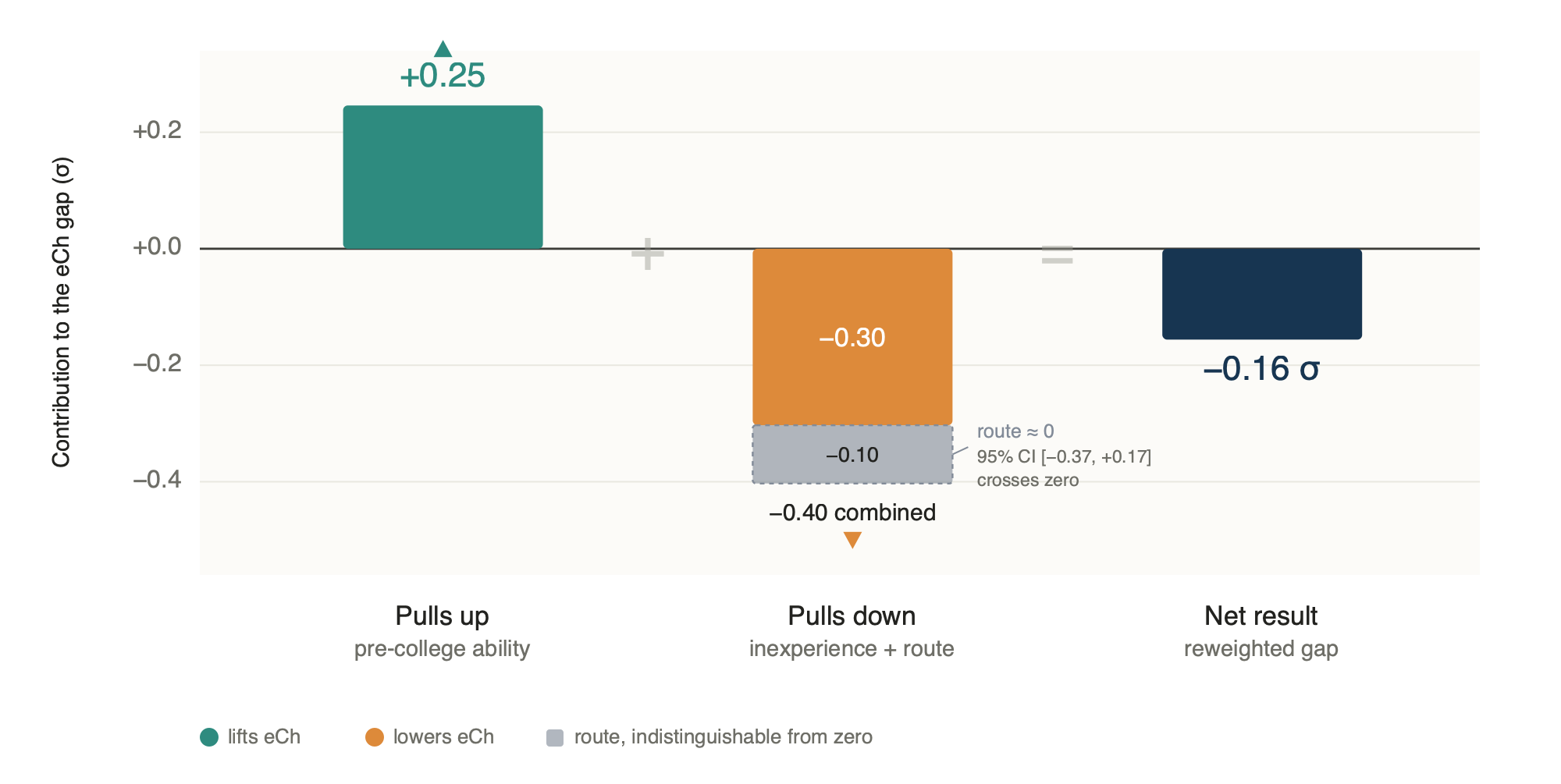
The headline result is that the gap is not one effect but two offsetting ones. Selection pushes eCh teachers up; inexperience pulls them down by slightly more; what is left over — the part you might attribute to the route itself — is small and statistically indistinguishable from zero. The result is best read as a failure to detect a route penalty rather than proof of exact parity, since the residual is estimated from a modest sample.
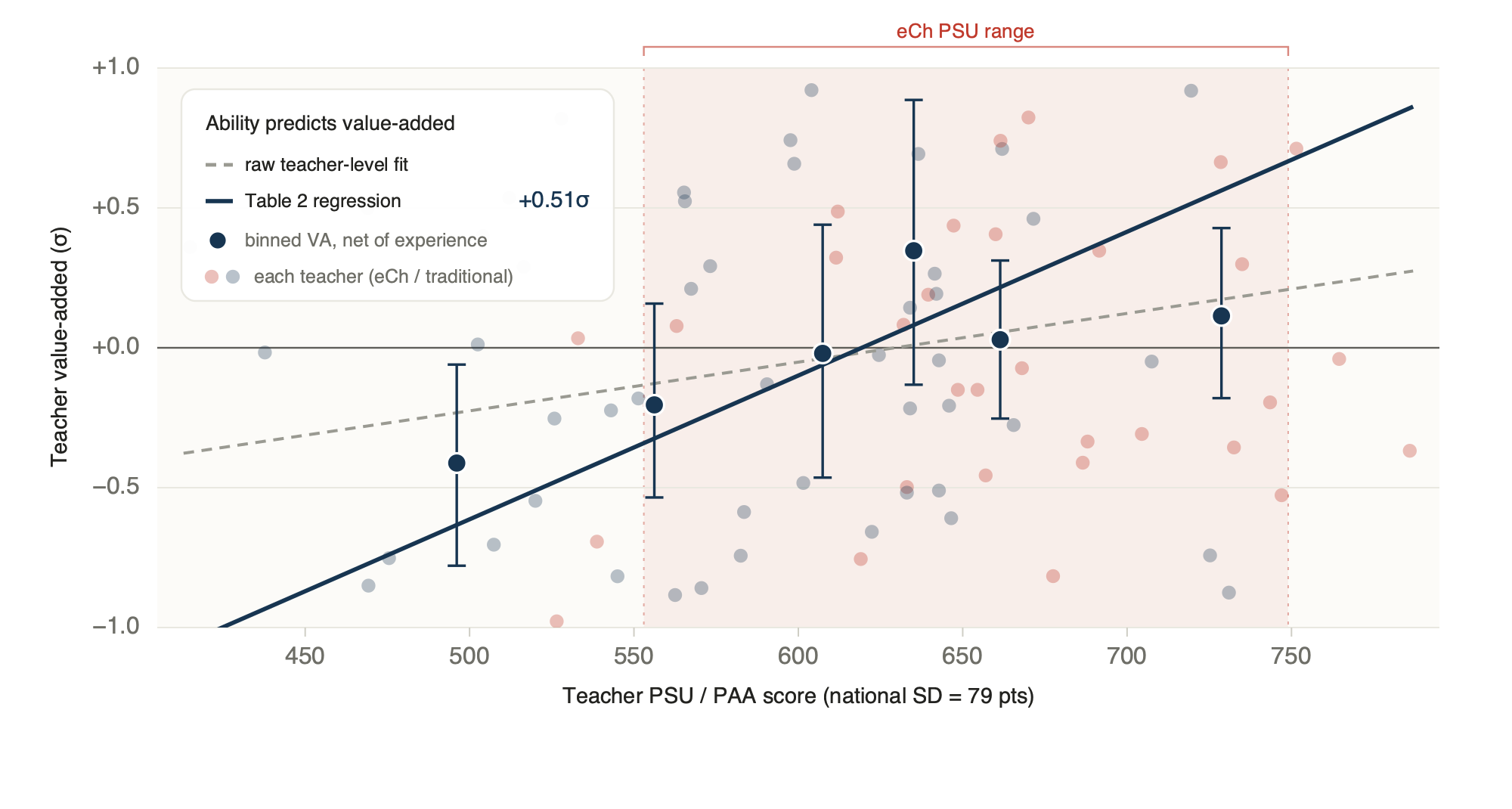
This is, to our knowledge, the first individual-teacher value-added estimate built on a country’s selective-university entrance exam — a measure taken before any teacher preparation. Pre-college academic ability is a strong, robust predictor of how much students learn, which is precisely what makes eCh’s recruiting model a plausible quality lever.
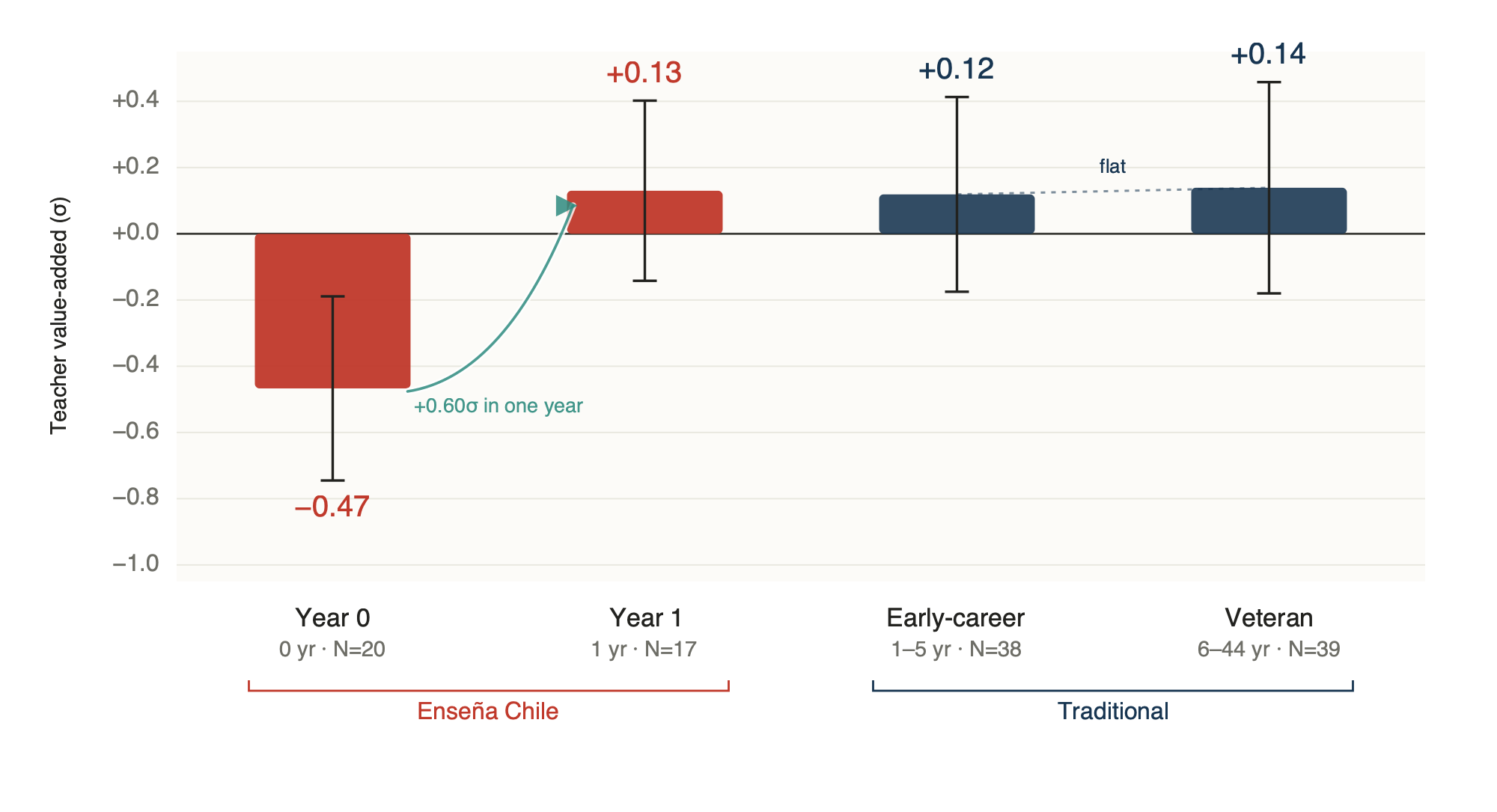
Because eCh teachers are concentrated in years 0–2, the within-program jump from the first to the second year captures the part of the experience profile that matters most for a two-year program. It also explains the policy tension: the program’s teachers mechanically leave just as their returns to experience are largest.
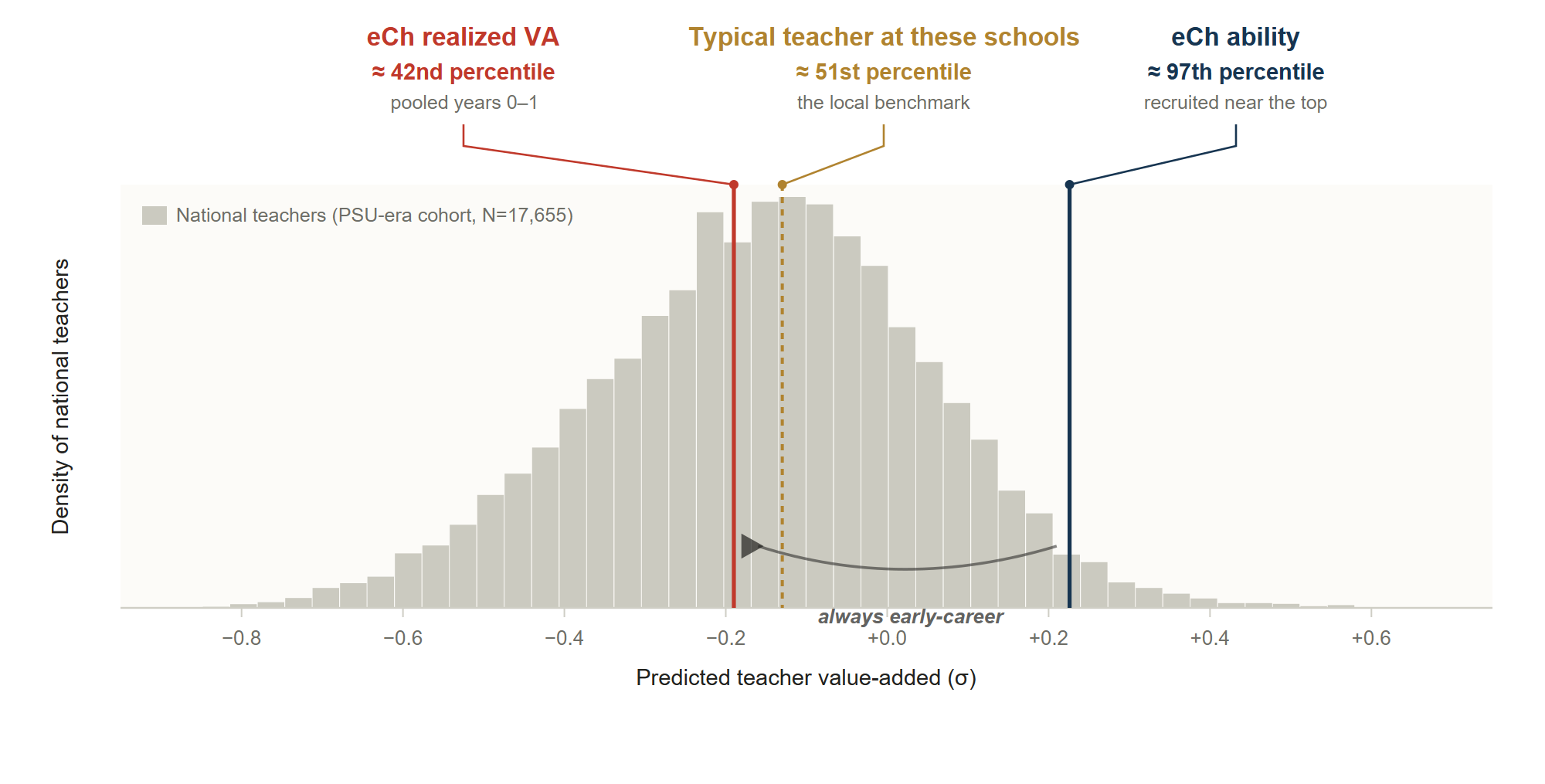
This figure makes the selection-versus-experience tension concrete: extraordinary on paper, middle-of-the-pack in realized effectiveness — with the gap between the two almost entirely a story about early-career experience.
Why it matters
For school systems facing shortages in secondary mathematics, the policy question is not simply whether four-year teacher colleges or short alternative routes produce better teachers on average. It is whether a system can attract high-ability candidates, support them through the steep early-career learning curve, and keep them in the classrooms that need them most. On this evidence, selective alternative pathways coupled with structured coaching can expand the supply of effective teachers without a detectable loss of instructional quality — provided they also confront the retention problem that fixed-term models create.
De Gregorio, Neilson & Gallegos, “Teacher Preparation, Pre-College Human Capital and Student Learning: Evidence from Enseña Chile.” Working paper. All figures regenerate from the replication code; values shown here are the current reweighted common-support estimates.